

 Refresh
HFI Taproot Model of Systems Change
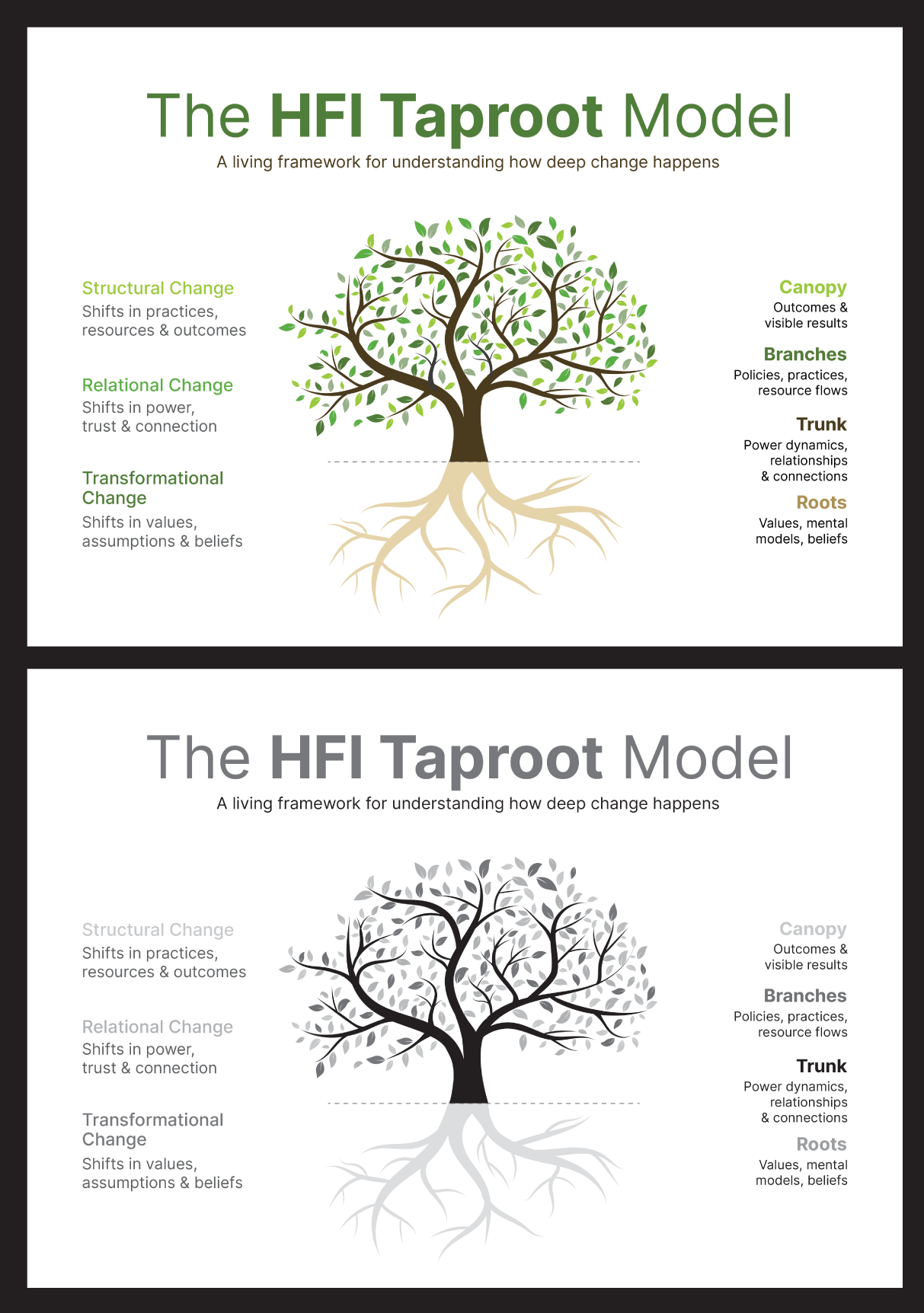
Want to win a job like this?
This customer received 30 graphic designs from 10 designers. They chose this graphic design from JK18 as the winning design.
Join for free Find Design Jobs
-
 US$280
-
 30 designs
-
 10 designers
Graphic Design Brief
HFI Taproot Model of Systems Change
I am seeking an original, elegant illustration for the "HFI Taproot Model of Systems Change:, a systems-change framework developed through the Handmade Futures Initiative (HFI).
The final illustration will appear in a forthcoming book and may also be used in presentations, workshops, educational materials, and online. We need an original design that we can own and copyright, not stock artwork, clip art, or an adaptation of an existing tree illustration.
The attached image is a conceptual reference only. Please do not reproduce or trace the tree. We are looking for an original interpretation of the model.
The Concept
The Taproot Model uses the architecture of a living tree to show different depths of a system:
CANOPY
Outcomes & visible results
BRANCHES
Policies, practices, resource flows
TRUNK
Power dynamics, relationships & connections
ROOTS
Values, mental models, beliefs
The central idea is that the parts of a system we can see are shaped by deeper forces that are often less visible.
The model also represents increasing depth of systems change:
Structural change — canopy and branches
Relational change — trunk
Transformational change — roots
The illustration should make this logic understandable even before someone reads a detailed explanation.
Most Important Visual Idea
We want the tree above ground and the root system below ground to visually echo one another.
The branches and roots do not need to be literal mirror images, but their overall footprint, weight, and branching patterns should feel closely related—an “as above, so below” quality.
This is important to the meaning of the model: the visible system above ground reflects and depends upon the less-visible system beneath it.
At the same time, this must clearly be a taproot system. There should be one strong central root extending downward from the trunk, with secondary roots branching outward from it but not too overwhelming for the central root. In this case please see the attached jpeg for what I mean. The taproot should be visually apparent without making the root system look unnatural.
The roots should feel every bit as substantial and important as the tree above ground, but they should be rendered in a lighter tone than the trunk and branches. This creates a visual distinction between what is readily visible above ground and the deeper, less-visible forces below ground without making the roots feel unimportant or merely decorative.
Visual Direction
The final design should be:
* Simple, sophisticated, and appropriate for a serious nonfiction book
* Created in both a color version and a grayscale version
* In the color version, restrained and sophisticated rather than brightly colored; the roots should be lighter than the trunk and branches
* In the grayscale version, the roots should similarly use a lighter gray value than the darker trunk and branches
* Clean enough to reproduce clearly in print at a relatively small size
* More like a conceptual/model illustration than a botanical drawing
* Organic but not whimsical
* Contemporary and timeless rather than trendy
* Visually balanced above and below ground
* Relatively slim/vertical, rather than a very wide spreading tree, to work well on a book page
* Legible when reduced in size
We prefer clean line work and restrained detail. Please avoid excessive leaves (though the attached example is a good amount), intricate root hairs, textures, shading, gradients, decorative flourishes, icons, or other elements that will become muddy when printed or reduced.
Layout
The tree should be the central visual element with no background.
A soft, fine dotted "ground" line should mark the ground level where the trunk transitions into the roots, similar to the attached reference image. The line should be subtle rather than a strong visual divider. It represents the threshold between the visible system above ground and the less-visible forces below it.
The model labels should correspond clearly to the appropriate parts of the tree.
We may later create expanded versions of the model that add reflection questions alongside each of these four elements, so the underlying illustration and layout should be flexible enough to accommodate additional text in future applications.
What I Do NOT Want
Please do not use:
* Stock tree or root illustrations
* AI-generated artwork
* Clip art or icons
* A realistic landscape or forest scene
* A highly detailed botanical illustration
* A decorative “Tree of Life” aesthetic
* A perfectly symmetrical ornamental tree
* A generic root ball without a visible central taproot
* Lots of colors, symbols, arrows, circles, or infographic elements
* Additional concepts or text not included in this brief
Simplicity is important. I want one strong visual metaphor, not an infographic filled with information.
Deliverables
The selected design must be 100% original artwork created for this project, with full rights transferred to us for publication, reproduction, adaptation, and copyright registration.
Please provide:
* Editable vector source file (Adobe Illustrator or equivalent)
* SVG
* Print-quality PDF
* High-resolution PNG with transparent background
* Full-color and grayscale versions
* A version with the labels
* A clean version of the tree/root illustration without labels
All text should remain editable and should not be converted permanently to outlines in the master source file.
Reference Image
The attached image shows the basic concept and hierarchy I want to preserve, but it should be treated only as a reference for the model—not as artwork to reproduce because it came from Canva.
